
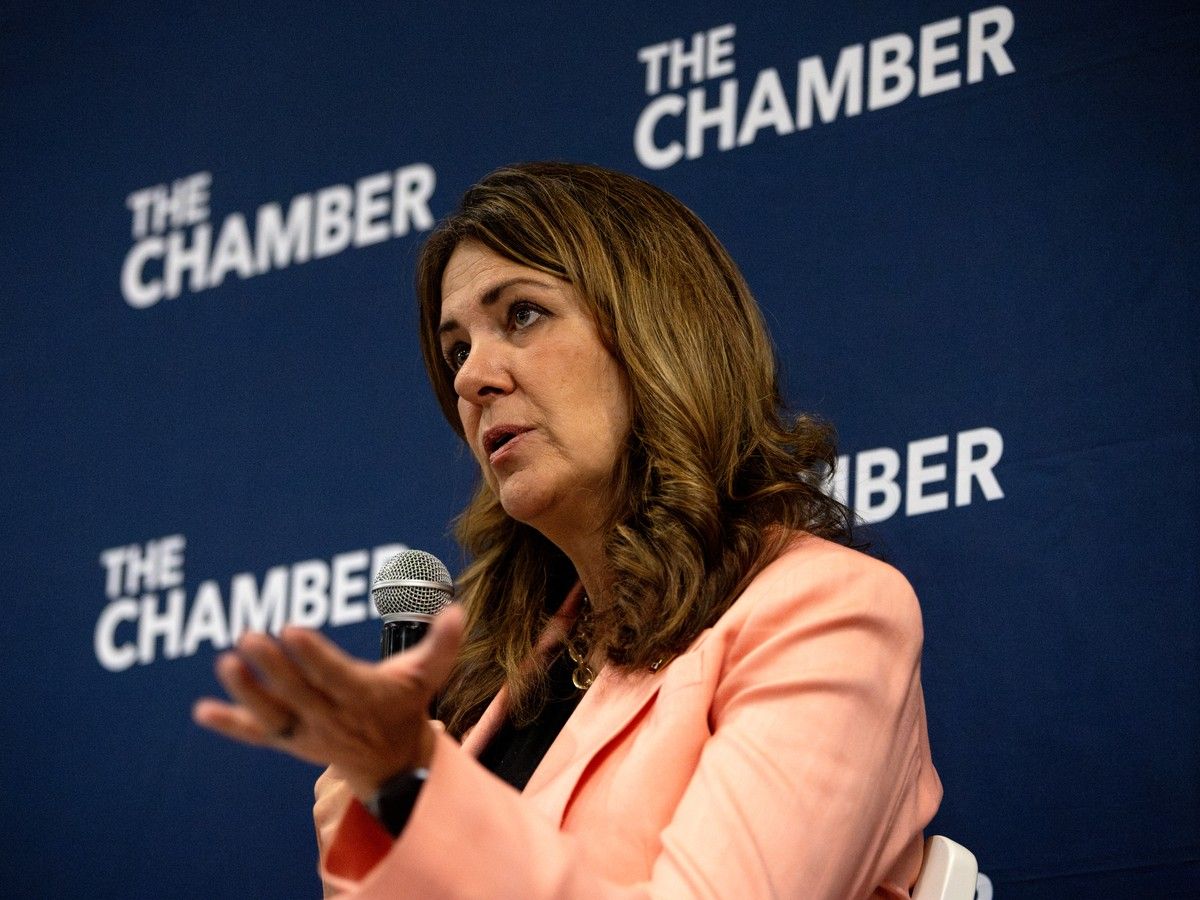
Alberta Premier Danielle Smith says she has voted for the province to remain in Canada and wants Albertans to follow her lead in the Oct. 19 referendum. Speaking Wednesday afternoon to the Leduc, Nisku and Wetaskiwin Chamber of Commerce, she urged voters to answer yes to nine of the ballot’s 10 questions, while rejecting the option to begin a process toward independence.
Smith said she had already voted for option one on the Alberta sovereignty question. “and I hope to be able to convince all of you to vote the same way,” she said. Option two would start a process leading to a binding referendum on separation, she said.
The premier acknowledged resentment directed at former prime minister Justin Trudeau, saying some Albertans were hurt by the previous decade and the former government’s approach to the energy sector. “Option 2 is to start the process that would lead to a binding referendum to separate,” Smith said. “But I can tell you what I often hear from people who are grappling with this issue, is that there’s a lot of people who were hurt by the previous 10 years under the former prime minister, and the coalition government that targeted our energy sector for extinguishment.”
Smith argued that the relationship with Ottawa has changed under Prime Minister Mark Carney. She said earlier Liberal governments gave little attention to Alberta and suggested the province had little to complain about, while Carney tells her, “I heard you and this is how I am responding to you.”
Her remarks came after Carney declared the Pacific Link pipeline to be in the national interest. Earlier Wednesday, the Department of National Defence also announced an expansion of its Edmonton operations. The timing framed Smith’s argument that the new Liberal government is not simply a continuation of its predecessor: when it comes to Carney, she said, “meet the new boss, same as the old boss” does not apply.
Smith said Alberta is now in a stronger position than it has been in years. “I am going to do whatever I can to convince as many Albertans as possible that Canada can work and hopefully win them over to that view,” she said. “That’s because the fight to make Canada work for Alberta is producing results. When Alberta stood up and spoke out and refused to back down, the rest of the country started listening. That’s why I believe our best days are still ahead, as a strong Alberta within a united Canada.”
She pointed to the removal of oil and gas caps and the approval of pipeline projects as evidence of progress. “Today, projects that seemed impossible two years ago are now moving forward. Now, the current Prime Minister has worked constructively with us on the Canada Alberta Energy Agreement,” Smith said.
The premier urged voters who want to send Ottawa a message or gain leverage to support the other nine referendum questions instead of choosing option two on sovereignty. Those proposals include greater provincial control over immigration numbers, requiring temporary foreign workers and international students to pay health-care premiums or education fees, and requiring proof of citizenship to vote.
“There’s a lot of people who want to send a message,” Smith said. “There’s a lot of people who think voting for option two will give leverage. If those are your reasons, I would say there is a better way to send a message or to give leverage. And that is to give us a mandate on the other nine questions… They ask for greater authority to prioritize economic migrants, to require temporary residents to pay a reasonable share of health-care and education costs, and require proof of citizenship to vote. The other questions are are also about working with willing provinces to secure reforms to the judiciary, to the senate and to how provincial autonomy is respected. They would ensure Alberta’s place in confederation is respected, no matter who governs in Ottawa. So, for me, that’s the path forward.”
Smith said a yes vote on those questions would send Alberta’s voice to Ottawa and seek reforms with provinces willing to work together on the judiciary, the Senate and respect for provincial autonomy. She said the proposals would protect Alberta’s place in Confederation regardless of which party governs federally. She closed with an endorsement of national unity: “I believe Canada can work. In fact, I believe it can work better every day.”
Based on reporting by Edmonton Journal.