
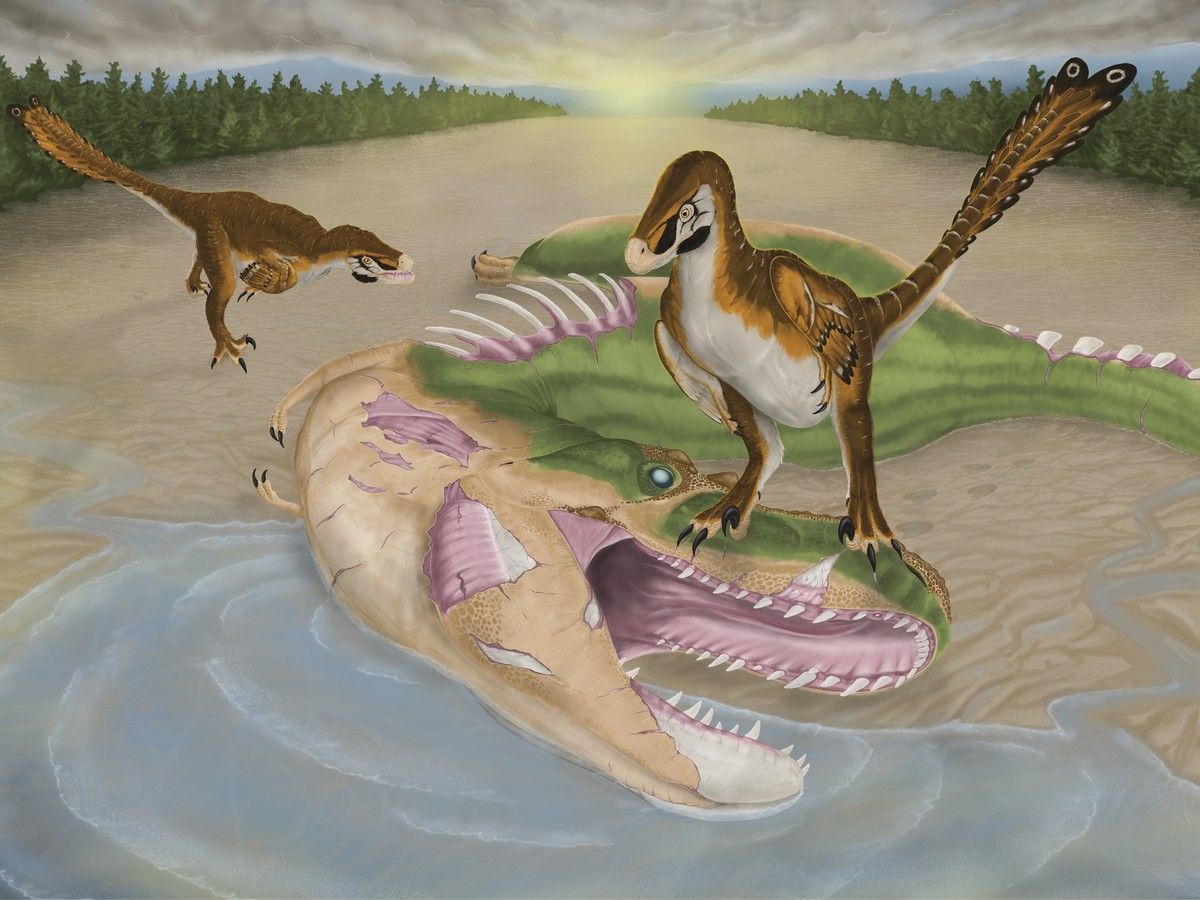
Tooth marks on fossil skull fragments from an eight-year-old Albertosaurus suggest that either a raptor or a much younger member of its own species fed on the dinosaur after it died near Drumheller. The finding, described in a new University of Alberta study, may be the first evidence that a raptor ate or scavenged a tyrannosaur, while also pointing to possible cannibalism among Albertosauruses.
The fragments were discovered in 2022 in Alberta’s Horseshoe Canyon Formation. The Royal Tyrrell Museum collected them and transferred them to the university after suspected tooth marks were noticed. The Albertosaurus was about six metres long and weighed 530 kilograms. Its cause of death is unknown.
Paleontology master’s student Joshua Doyon examined the fragments for a study published in the Journal of Paleontology. He concluded that the tooth marks were probably made after the animal died because the bones showed no signs of healing. To identify possible feeders, he measured the spacing between marks on the jaw and compared it with the teeth of dinosaurs known to have lived in the area at the time.
That comparison produced two candidates: a dromaeosaurid, a type of raptor, and a baby Albertosaurus. Philip Currie, the university’s lead paleontologist and Doyon’s supervisor, said in a university media release: “This turns everything on its head, because you’re dealing with a very small dinosaur eating a very big, mean, nasty dinosaur like a tyrannosaur.”
Doyon said the second possibility would mean a young Albertosaurus ate a larger, sub-adult animal. “If it is a young Albertosaurus, this would be an event of cannibalism - by a baby, about two metres long, eating a larger sub-adult,” he said. The animal found with the tooth marks has been described as an eight-year-old Albertosaurus, a teenage cousin of Tyrannosaurus rex.
The researchers have not established which of the two animals left the marks. The study could indicate a more complex food web in the dinosaur ecosystem than previously understood, or that young Albertosauruses sometimes ate larger members of their species.
For Doyon, the research also marks an academic milestone. “We are lucky to be able to get involved in research so early in our careers,” he said, crediting the university’s proximity to the badlands and the Royal Tyrrell Museum, as well as its collection of dinosaur specimens.
The discovery adds to other University of Alberta paleontology research covered by the Edmonton Journal, including scientists’ work refuting claims about T. rex intelligence and the finding of Alberta’s oldest plesiosaur fossil at a Mildred Lake oilsands site.
Based on reporting by Edmonton Journal.