
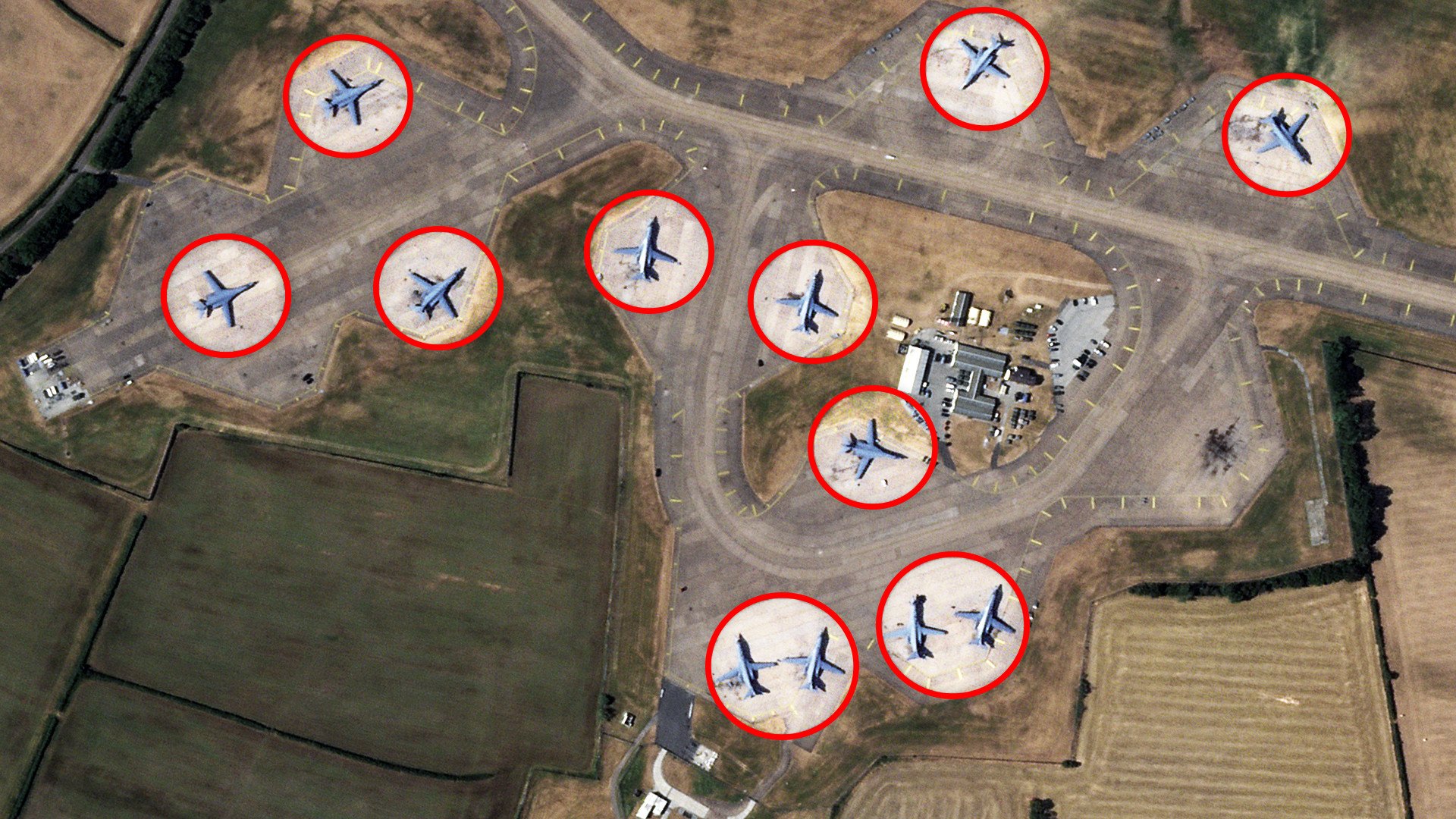
Multiple reports now say that U.S. Air Force B-1 Lancers left the United Kingdom over the weekend due to the threat of an Iranian-directed near-field drone attack broadly akin to Ukraine’s Operation Spiderweb that decimated Russian bombers. Though many specific details are still unconfirmed, this is an entirely plausible mode of attack that TWZ has been warning about for many years now.
Short- and long-range drone threats against parked aircraft have now morphed fully from theory to reality, as also demonstrated by losses in the course of the conflict with Iran, and even non-state actors are increasingly brandishing these capabilities. Despite the increasing dangers posed to planes out on open flightlines, the Pentagon continues to drag its feet on building hardened aircraft shelters and other fortified air base infrastructure.
Before the hasty and unexpected departure of the bombers on Sunday, B-1s had been deployed to RAF Fairford continuously since March, initially in support of Operation Epic Fury against Iran. A contingent of B-52s had also conducted strikes on Iran from Fairford, but left back in July. The base is a major operational hub for the U.S. military in the United Kingdom, and regularly hosts strategic aircraft, including bombers and U-2 spy planes.
Dan Rivers, U.S. correspondent for ITV News in the United Kingdom, was among the first to report on Monday that the B-1’s quick departure had been prompted by concerns about a potential Spiderweb-like drone attack ordered by Iran, citing an unnamed source. Other outlets have subsequently reported similar details, all sourced to anonymous U.S. and British officials.
Ukraine’s unprecedented Operation Spiderweb last year involved simultaneous covert near-field attacks using explosive-laden quadcopter-type drones on airbases across Russia. At least 10 Russian bombers, as well as a variety of other aircraft, all parked on open flightlines, were destroyed.
“They didn’t fly out by accident,” U.S. President Donald Trump told reporters during a gaggle at the White House on Monday when asked about why the B-1s had left Fairford. “There were some threats.”
A satellite image showing B-1s parked in the open at RAF Fairford on July 29, 2026. PHOTO © 2026 PLANET LABS INC. ALL RIGHTS RESERVED. REPRINTED BY PERMISSION
“I can’t tell you that, but if they did, they’ll suffer greatly,” Trump added in response to a separate question about whether Iran might have been managed to get weaponized drones into the United Kingdom.
“What you saw there was the Secretary of War [Pete Hegseth], out of an abundance of caution, trying to protect our guys,” U.S. Vice President J.D. Vance said during a separate press engagement on Monday. “We do feel, with some confidence, that the Iranians are - they’re trying to do what the Iranian state has done for 49 years, which is engage in acts of terrorism against the United States, and a lot of other people, as well. So, we are being extremely cautious.”
Another satellite image offering an overall view of RAF Fairford. Google Earth
It’s also worth noting here that British authorities had arrested five men on suspicion of driving bomb-laden vans toward the base back on September 27. Those individuals were released on bail after no explosives were found in the vehicles. U.S. and British Officials have also raised the possibility of an Iranian link to that incident.
“We’ve documented what happened [near Fairford] last week. I wouldn’t just directly tie that to the move that was made,” U.S. Secretary of State and National Security Advisor Marco Rubio also told members of the press on Monday. “The only reason why you guys are focused on how many planes are at Fairford is because of the threat that happened last week.”
“We have confidence in the security of all of our bases, because all of our bases are [sic] theoretically could be threatened at any moment,” he added.
Rubio’s comments notwithstanding, the remarks from Trump and Vance make clear that there was some recent threat intelligence that contributed to the decision to pull the bombers from Fairford. There are still many questions about the exact nature of the potential attacks, and how imminent, or not, the danger may have been.
Regardless, as mentioned, the prospect of a near-field drone attack on a base like Fairford carried out by actors in close proximity is extremely plausible, and the barrier to entry to such an operation is relatively low. Spiderweb may have thrust this reality into the public consciousness in dramatic fashion, but the danger well predates that operation, and even the start of Russia’s all-out invasion of Ukraine in 2022.
TWZ has been highlighting exactly these kinds of threats in the course of a decade or so now of regular reporting on drone incursions over U.S. and foreign military facilities and critical infrastructure, as well as American naval vessels operating offshore. Langley Air Force Base in Virginia and Barksdale Air Force Base in Louisiana, some of America’s most strategic airbases domestically, are among the facilities that have had to grapple with this in the past. After the Langley incident, in particular, it had become clear to the larger public what we had been reporting for many years, that the United States does not control the airspace over even its most critical military installations.
This all extends overseas, as well. In November 2024, there was a rash of drone sightings over and around several airbases in the United Kingdom, including RAF Fairford. This has been an issue more broadly in Europe in recent years, as well. This was only further underscored by an attempted drone attack on a Ukrainian An-124 at an airport in Germany in August, which authorities in that country have blamed on Russia.
New footage of yet another act of Russian terrorism on EU soil, showing the drone loaded with explosives on the tarmac at Leipzig/Halle Airport, just meters from a Ukrainian Antonov An-124 cargo aircraft.
According to German authorities, the drone was carrying an improvised… https://t.co/eCZaLfz9yx pic.twitter.com/DbRz87wgIv
- SPRAVDI - Stratcom Centre (@StratcomCentre) August 5, 2026
A drone attack on Fairford would also not necessarily have had to come from somewhere very close by. Longer-range one-way attack drones are steadily proliferating, and can be launched using a variety of methods from positions on the ground, as well as vessels at sea. TWZ explored the very real threat of sea-based drone attacks, including ones conducted covertly, and Iran’s specific ability to carry them out globally, following the leak of an FBI alert back in March.
The proliferation of lower-end one-way-attack drones has ‘democratized’ precision-guided attacks, even for non-state actors. The fielding of automated targeting capabilities, driven by developments in artificial intelligence and machine learning, is also becoming more and more widespread. That technology will soon enable these weapons to find and strike even moving targets on their own. Even without anyone at the controls and without the drone putting out any detectable radio emissions, very effective precision attacks can still be launched at static targets, like known parking areas for aircraft at airbases, just by using basic map coordinates or Google Earth. It’s also worth pointing out here that the definition of a stand-off attack is becoming increasingly blurry, with even quadcopter-type drones capable of flying miles away to conduct a kamikaze attack on a target based on a set of GPS coordinates.
Ukrainian Saker UAV with AI capabilities. The video shows the process of target recognition. It has reportedly already been put to use several times against Russian targets. pic.twitter.com/NVNJyxUjGP
- NOELREPORTS (@NOELreports) January 25, 2024
Overall, it is an indisputable fact that aircraft sitting exposed on a flightline are particularly vulnerable to drone attacks, as well as other threats. This is something U.S. military officials have acknowledged themselves. Fairford, where B-1s and other bombers have no option but to park out in the open in well-established areas that are plainly visible from outside the base’s immediate perimeter, is indicative of how American military aircraft are generally positioned on the ground abroad and at home.
As we wrote all the way back in 2017:
“Similar swarming strikes could be unleashed behind the front lines as well, with hugely expensive and low density/high demand combat aircraft being especially vulnerable to this sort of tactic-something General James Holmes alluded to inadvertently while speaking to the Air Force Association, stating:
‘Imagine a world where somebody flies a couple hundred of those and flies one down the intake of my F-22s with just a small weapon on it.’
Actually, it would be even easier to just strike the jets as they sit idle and vulnerable on the flight line. One swarm could see a whole squadron of tightly packed fighters destroyed without even having a chance to fight back.“
This picture of a B-1 at Fairford on March 7 shows how bombers and other aircraft are typically parked at the base. The line of photographers along the fence line also underscores how close those parking spots are to the base’s immediate perimeter. JUSTIN TALLIS / AFP via Getty Images
With all this in mind, a heated debate has emerged in the past few years in and around the U.S. military about the value of investing in new hardened aircraft shelters, as well as other fortified infrastructure.
To date, the U.S. Air Force, in particular, has put virtually all emphasis on surface-to-air missiles and other active defenses, as well as the dispersal of aircraft, over physical hardening. The conflict with Iran, in which a number of American military aircraft have been damaged or destroyed on the ground by drone and missile attacks, has underscored the limits of these strategies.
Second angle. pic.twitter.com/NUupdRkdm9
- OSINTtechnical (@Osinttechnical) March 29, 2026
“I’m not a big fan of hardening infrastructure,” Gen. Kenneth Wilsbach said at a roundtable at the Air and Space Forces Association’s main annual symposium in 2023, offering a prime example of this viewpoint. “The reason is because of the advent of precision-guided weapons … you saw what we did to the Iraqi Air Force and their hardened aircraft shelters. They’re not so hard when you put a 2,000-pound bomb right through the roof.”
Wilsbach was commander of Pacific Air Forces (PACAF) at the time. He subsequently became head of ACC and is now Chief of Staff of the Air Force, the service’s top officer.
“I think that I don’t want to spend a lot of money on hardening shelters. Unless you’re going to send something 100 feet or more underground, we can blow it up, and so can they,” Wilsbach said in an interview with Breaking Defense in July of this year when asked explicitly if his position changed. “So, the economics of building a shelter that is impervious to a strike doesn’t work.”
U.S. Air Force Chief of Staff Gen. Ken Wilsbach speaks during an all-call with personnel at RAF Mildenhall, another base in the United Kingdom, on July 13, 2026. USAF
“I think the economics favor defending your airspace, defending your ground space with systems that can defeat the incoming rounds, versus building a shelter,” he added. “Some people would argue, well, you should do both. Well, that’s even more expensive. And the other thing is, the shelter doesn’t go anywhere.”
It is fair to point out that typical above-ground hardened aircraft shelters are not invulnerable, especially to attacks involving ballistic, cruise, and certain air-launched threats. There are also substantial cost and other factors to consider when it comes to any major military construction effort.
That being said, having more hardened infrastructure also imposes costs and complexities on opponents, who have to dedicate more advanced and costly munitions and other resources to...