
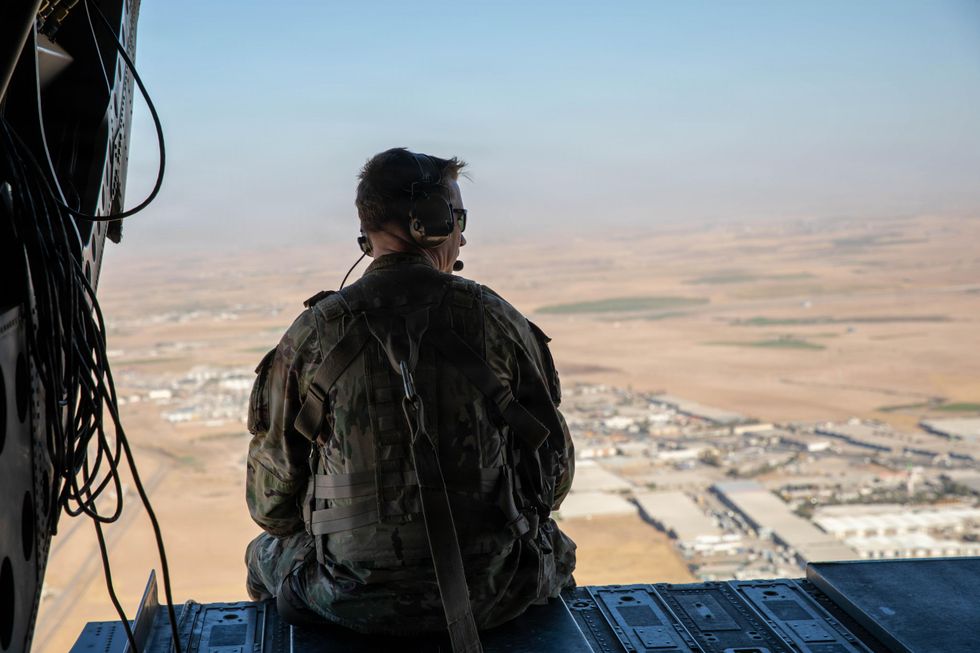
The United States completed the withdrawal of its troops from Iraq on Sept. 30, prompting Iraq to declare “Sovereignty Day” and celebrate what it described as the end of U.S. occupation and the return of full sovereignty to the Iraqi people. The departure marks the end of a military mission that began in 2014, when a few hundred American soldiers returned at the Iraqi government’s invitation to support an Iraqi Army collapsing under the fight against ISIS.
The withdrawal is limited in scale compared with the large forces stationed in Germany and Japan after the Second World War. Operation Inherent Resolve’s troops were not an occupation force and did not challenge Iraqi sovereign control, according to the account. Still, the mission had become a political liability, providing anti-government militias with a convenient rationale to preserve their independence, keep weapons and exert influence in the streets and in Parliament.
The U.S. departure does not require an end to military support for Iraq. Security co-operation can continue without permanent bases or large combat garrisons through assistance, intelligence sharing, counter-terrorism co-ordination and specialized training delivered from outside Iraq or through temporary training and equipping missions. A security co-operation office, the Office of Military Assistance-Iraq, will remain at the U.S. embassy to facilitate those programs.
The question of retaining a residual U.S. force has drawn support from some voices in Washington, but the source argues that a diplomatic and development effort is the reasonable course. It says the United States followed that approach after its first withdrawal in 2011 and should continue it. The Strategic Framework Agreement, signed in 2008 by U.S. President George W. Bush and Iraqi Prime Minister Nouri Al-Maliki, envisioned a post-military relationship and was intended to guide policy going forward.
Critics of the withdrawal say Iraq’s security forces are not ready to guard the country’s borders or maintain internal order. Senior Iraqi officials, including the national security adviser, have rejected that premise, the account says. A Higher Military Commission formed by U.S. military leaders and Iraqi counterparts carried out a methodical assessment against benchmarks to gauge the forces’ capabilities.
The assessment found the Iraqi military to be one of the region’s largest conventional forces, sufficiently equipped and organized, and capable of handling internal and external threats. That preparation does not guarantee the political will to fight any particular adversary. The military has long faced political and sectarian divisions, and the account argues that a small U.S. deployment would be unlikely to change those underlying conditions.
A continued American military presence could also have fuelled instability. Illegal Iranian-backed factions have described attacks on U.S. troops and shared military facilities as resistance to occupiers, while arguing that major weapons stocks are needed to fight American forces. Prime Minister Ali al-Zaidi’s administration has made disarming militias that refuse to answer to the central government a major policy goal. The account says U.S. troops in Iraq work against that effort.
Some analysts argue that a small U.S. force could deter further Iranian expansion. The account doubts that claim, noting that Iran’s proxies have suffered serious blows to their strength and influence in Gaza, Lebanon and Syria. It says Iran is likely to push harder to preserve and expand its proxy strength in Iraq, regardless of al-Zaidi’s disarmament program.
The current war between the United States and Iran adds another risk: U.S. forces in Iraq could be targeted by Iranian rockets and missiles in retaliation for American attacks in Iran. Keeping Iraq and its territory out of a prolonged U.S.-Iran war should therefore be a U.S. objective, the account argues.
The political and legal prospects for keeping troops in Iraq are also uncertain. The Iraqi government made clear it would not renew the 2008 Status of Forces Agreement in 2012, and the account says Iraq’s Parliament is equally unlikely to renew it in 2027. Neither the U.S. administration nor the American public shows an appetite for another “forever war” in Iraq. An existential threat to either country could change that outlook, but the account says such a low-probability event should not determine U.S. policy.
The U.S. military returned to Iraq in 2014 to help the Iraqi Security Forces defeat ISIS. The mission later expanded to include the group’s defeat in Syria, and the account says that task has been accomplished. It recommends grounding future relations in the 2008 Strategic Framework Agreement, whose priorities include economic, financial and trade co-operation; energy, diplomacy and political co-operation; cultural, educational and scientific exchanges; health and environmental co-operation; and law enforcement and judicial co-operation.
Those priorities remain relevant in Iraq, the account says, and U.S.-Iraq relations should be led through the agreement’s pillars rather than a military mission. The last quarter century has demonstrated the value of that division of work, it argues, with political, economic and diplomatic problems best handled by the Department of State rather than the Pentagon.
Based on reporting by Responsible Statecraft.