
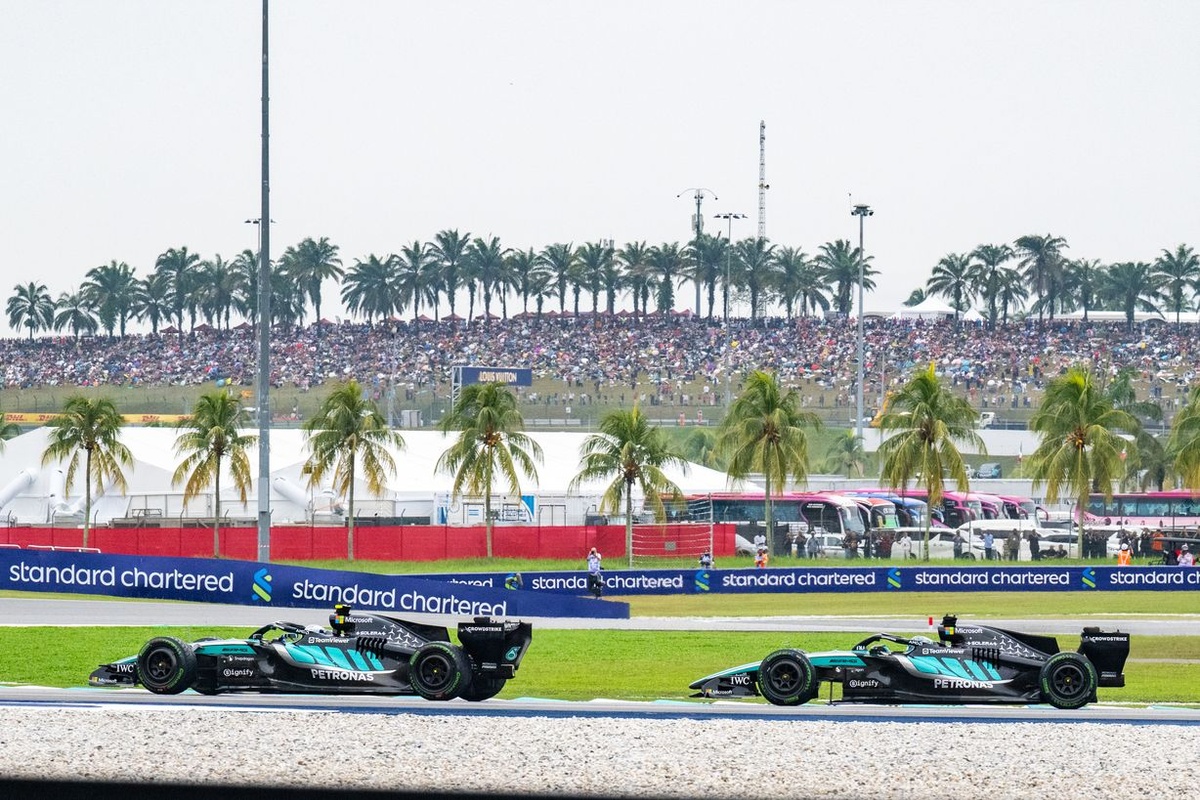
Mercedes will investigate why its revised W17 struggled to deliver its usual pace at Sepang, after a weekend in which the circuit’s temperature and rough surface made it difficult to assess the update package. The team had introduced a new floor and sidepod design for Formula 1’s first visit to the Malaysian track in nine years. It was on course for a double podium before George Russell retired late in the race with a powertrain problem.
The team said during the weekend that the changes were performing well in faster corners, but the car did not work as expected around the circuit as a whole, especially in slower turns. Mercedes deputy team principal Bradley Lord said the drivers had to use atypical inputs in those corners to make the car respond. That behaviour, in turn, compounded the difficulty of managing tyre temperatures.
“The combination potentially of update, track temperature and track surface caused an interaction and a set of behaviours that meant the car was not in its usual happy state, that the drivers were having to turn the car on the throttle in the slow corners,” Lord said in the team’s usual post-race debrief, shared on its social media channels.
“That was further exacerbating the challenges with tyre temperature. So that's not an easy thing to unpick.”
Lord described the issue as a complex problem involving several interacting factors. Mercedes was working at its factory and in Singapore to establish what steps to take next and how to confirm that the update was functioning as intended. The investigation is relevant to development of both this year’s car and next year’s model.
“It's a bit of a 3D problem that we need to work through and then figure out exactly what steps we take going forward to make sure we've got the base understanding that we need to understand that the update is working well and that we're heading in the right direction in our development, not just for this year's car but for next year as well,” Lord said.
“So that's work that's going on at the moment back in the factory and also over in Singapore in order to establish exactly what the plan is for the coming days and the race weekend in Singapore.”
Sepang’s surface may have affected the car through both tyre behaviour and airflow beneath the chassis. The first connection is the direct contact between the road and the tyres. The circuit’s roughness contributed to excess heat because the tyre was strained more as it moved over the uneven surface.
A tyre deforms elastically under load and returns to its natural shape when the load is removed. Gaps in the track surface can partly fill with rubber, producing mechanical grip. The repeated loading and unloading of the contact patch, a process known as hysteresis, wastes energy as heat; greater deformation to fit the surface can increase heat generation at the tyre’s surface.
The second possible factor is aerodynamic. Formula 1 cars use aerodynamic components to create downforce, but also to shape airflow and accelerate it so the rest of the car works efficiently. Track roughness can alter the airflow under a car, and teams account for surface characteristics in simulations because no circuit is perfectly smooth.
Computational fluid dynamics simulations apply a friction coefficient to the lower walls of the model’s domain to help represent the flow field. Wind tunnels may use textured belts for a similar purpose. A distinctive surface such as Sepang’s can interact differently with the airflow under the car, changing the boundary layer, the immediate theoretical layer of fluid around a surface, and potentially contributing to turbulence through flow separation.
McLaren team principal Andrea Stella had alluded to the aerodynamic mechanism. The account of the Sepang problem also identified Andrea Kimi Antonelli and Max Verstappen of Red Bull Racing in a photo caption credited to Joe Portlock of Getty Images. A second caption identified Antonelli and credited photographer Srinivasa Krishnan.
Mercedes expects its understanding of the car to be clearer at Singapore, where the team has more data. That should make the car’s relative performance easier to assess from both tyre and aerodynamic perspectives. The Singapore race weekend was the immediate focus of planning as the team continued its work on the update.
Lord also confirmed that Russell’s retirement resulted from a mechanical failure on the power unit side, while stressing that its precise cause remained unknown. Mercedes had recovered the car and completed an initial inspection, but further work was needed to identify the root cause.
“Our investigation so far, we've got the car back, we've been able to do a first inspection. It's clearly a mechanical failure on the PU side,” Lord said.
“Exactly what the root cause is, we still need to determine, but the consequence was clear for all to see. A devastating blow for the team and 15 points lost, but most especially, of course, for George, who was on for a very, very solid podium finish.”
Based on reporting by Autosport.