
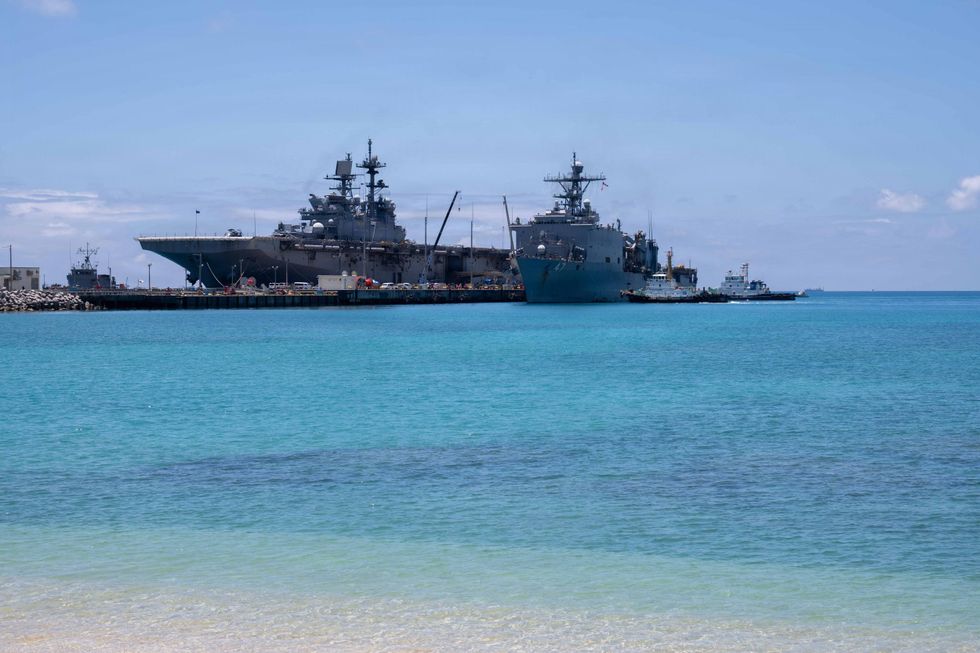
A U.S. ground-based missile system that can fire Tomahawk missiles will remain in Japan after military exercises, rather than return to the United States, Japan’s defence ministry announced late last month. The Typhon system is to be stored at Kadena Air Base in Okinawa, at least temporarily. The decision has raised concerns about increased military tensions along the first island chain, the stretch of East Asia that includes Japan, Taiwan and the Philippines.
Tokyo has sought to limit concern, saying the decision supports training rather than warfighting and that no U.S. Army units will deploy with the system. Those assurances may not prevent the move from being viewed as a change in the U.S. military posture. The announcement came soon after Chinese President Xi Jinping visited Washington, an apparent contrast with Donald Trump’s outreach to Beijing.
The source characterizes that contrast as part of the Trump administration’s approach to Asia. Trump has called for a “decent peace,” while his administration is also building what it describes as a denial defence along the first island chain. The source argues that these aims could undermine efforts to stabilize the U.S.-China relationship and increase the risk of conflict between the two powers over the medium term.
The National Defense Strategy, published earlier this year, sets out both objectives. It calls on the U.S. military to “set conditions for a balance of power in the Indo-Pacific that allows all of us-the United States, China, and others in the region-to enjoy a decent peace.” It also states an intention to “erect a strong denial defense along the first island chain to…ensure that the Joint Force always has the ability to conduct devastating strikes and operations against targets anywhere in the world.”
The Pentagon’s rationale treats the denial defence as a prerequisite for peace, but the source rejects that premise, arguing the goals are incompatible. A denial posture is intended to raise the costs of Chinese aggression against neighbouring countries, especially Taiwan, by positioning U.S. forces and weapons close to China. From Beijing’s perspective, the same deployments may appear threatening and aimed at containing China.
The U.S. military has long centred its Asian posture on the first island chain. Around 80,000 U.S. military personnel are stationed at bases in Japan, South Korea, the Philippines and even Taiwan, according to the source. The forces include dozens of fighter jets, warships, artillery, longer-range missile systems and air defences at U.S. bases along the chain.
The Trump administration has focused on strengthening that presence. In addition to the Typhon system in Japan, Washington plans to upgrade fighter jets deployed at bases in the country. It is also building new military infrastructure on Luzon, the Philippine island closest to Taiwan, and changing the types of forces deployed at strategic locations in Japan, the Philippines and South Korea. In the future, personnel at those locations are expected to have new anti-ship and anti-aircraft missiles intended to prevent China from projecting military power across the Pacific.
Washington describes the posture as defensive, but the source says China may view intermediate-range missiles near its mainland, fighter jets at bases only a few hundred miles away and warships operating off its coast as aggressive. Those deployments could be seen as efforts to limit China’s power and interfere with its ambitions in its near abroad. The source compares that perception with Washington’s own claims in the Western Hemisphere under the “Donroe Doctrine.” China could also regard the forces as having hostile intent and working against its security interests.
The source links U.S. investments along the first island chain with China’s military response. It says Beijing has deployed more missiles on Chinese territory opposite Taiwan and expanded patrols in the South China Sea and closer to Japan. Rather than bringing about the “decent peace” set out in U.S. policy, the resulting competition could leave the region less secure, in an arms race and closer to war.
As an alternative, the source proposes shifting the U.S. military’s centre of gravity from the first island chain to the second, which is made up of U.S. territories and Compact of Free Association states. The United States would reduce and consolidate forces and military assets at bases in Guam, Palau, Micronesia, Tinian and other locations, while keeping at most a small number of rotational forces in Japan and the Philippines.
That realignment would also require narrower U.S. military commitments, replacing expansive mutual defence treaties with a more sustainable set of limited security partnerships. The source says a gradual change could give countries such as Japan time to invest in their own defence and reduce the risk that they would feel abandoned. The United States could maintain partnerships with current allies through rotational deployments, the option of support during a military crisis, joint defence industrial projects and economic investment.
The source’s main argument for moving forces is that the U.S. war in Iran shows the current first island chain presence is not sustainable or survivable. Supporters of the existing posture say bases along the chain are needed to disperse U.S. forces and assets for contingencies such as a war over Taiwan. But the source argues that bases in Japan and the Philippines cannot serve that purpose if they cannot be defended effectively. Moving forces to the second island chain would not make them invulnerable to Chinese attack, but could make them more defensible and reduce the risk of conflict with China.
A second island chain strategy could also better match what the source describes as core U.S. national security interests. It could protect U.S. access to regional economic markets from physical interdiction and help balance Chinese power in East Asia, especially if paired with a coherent U.S. economic strategy. By contrast, the current first island chain defence could draw the United States into wars it does not need, including a conflict over Taiwan that the source says the U.S. military appears unprepared to fight. It could also weaken allies’ incentives to fund their own defence and pursue diplomacy with China.
Critics of a U.S. pullback warn that it could embolden Beijing to seize Taiwan, assert dominance over Japan and other countries, and eventually push the United States out of Asia. The source says there is little evidence for those predictions. China depends on trade and has little incentive to exclude the United States from regional economic networks; it also lacks the military capabilities to become the region’s sole hegemon, particularly if Japan and South Korea build their own military capacity and work to balance Chinese power.
A pullback would carry other risks, including possible efforts by Japan and South Korea to develop nuclear capabilities or invest too heavily in offensive forces, which could temporarily worsen regional insecurity. The source says those risks could be managed through careful diplomacy and economic policy, and by making changes to U.S. commitments gradually. Washington could explain its plans to China and make clear it intends to remain a Pacific power, while accepting a narrower role.
China would welcome a smaller U.S. military presence in Asia, particularly near its shores, the source says. It argues that a reduced footprint could still serve U.S. interests, with regional middle powers taking greater responsibility for stability by reaching an understanding with Beijing that accommodates its security interests and makes further military competition unnecessary.
Based on reporting by Responsible Statecraft.