
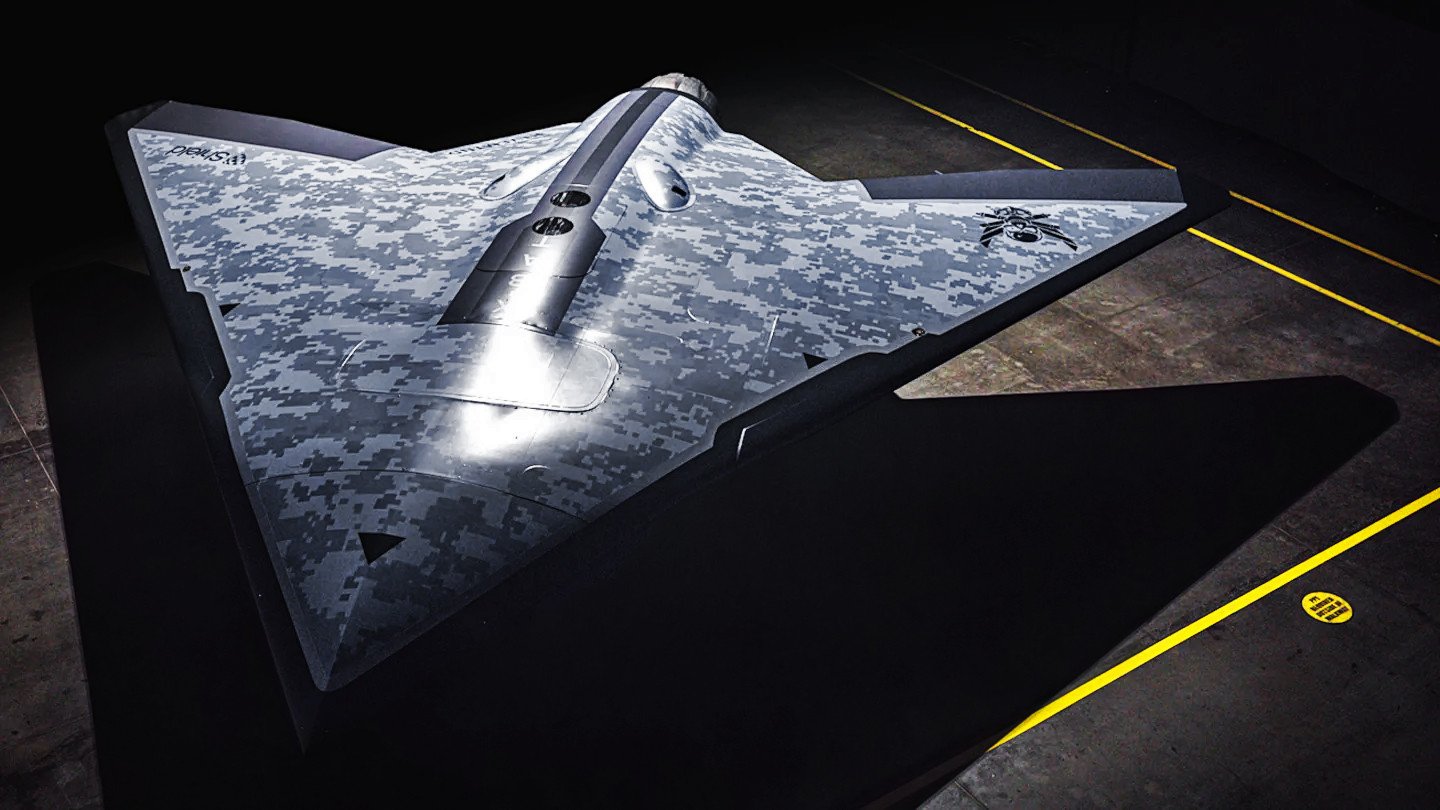
The War Zone has reported:
Shield AI has released the first video of X-BAT 001, a full-scale prototype of its jet-powered, tail-sitting drone designed to take off and land vertically. The aircraft is the first of two full-scale prototypes the company plans to build, and is being moved from Shield AI’s main hub in Frisco, Texas, to its flight test facility in Newton, Kansas. The two locations are known as X-Forge 1 and X-Forge 2, respectively.
The tailless aircraft is intended to combine vertical takeoff and landing with stealth features and the ability to perform fighter-like missions. The U.S. Navy has already given the programme a significant vote of confidence and hopes to see the drone become an operational capability on an aggressive timeline. Shield AI first unveiled X-BAT to the public last year.
The prototype’s appearance reflects changes the company has made since the concept was introduced. At the Navy League’s Sea-Air-Space 2026 exposition in April, Shield AI displayed a half-scale model with a substantially revised planform. The original “cranked kite” layout had been replaced by an arrowhead-shaped profile with a straight leading edge and a more pronounced sweep.
X-BAT 001 generally resembles that half-scale model and more recent computer renderings, but the prototype includes visible differences. Its thrust-vectoring exhaust nozzle projects farther behind the aircraft than the wing trailing edges. On earlier models and renderings, the nozzle sat farther forward, more inset into the rear fuselage.
The rear of the central body also has two prominent bulges, one on each side of the dorsal spine. Each bulge has a small opening at its front, and the top of the spine has two circular openings covered by mesh screens. Small fans may be visible inside the openings. These features were not apparent on previously displayed models or renderings, and their purpose has not been disclosed.
Shield AI declined to comment when asked about the bulges and openings. They could be connected to the propulsion system, though the company has not confirmed that. The thrust-vectoring nozzle provides pitch and yaw control, while Shield AI has previously said that bleed air routed through thrusters in the wings will provide roll control.
The prototype’s top surface also shows panel lines with circular edges. That differs from the saw-tooth-edged paneling depicted on earlier models and renderings. An insignia on the upper surface of the left wing features a skull and other motifs. Shield AI says it is intended as a tribute to all four branches of the U.S. military.
“X-BAT 001 is a development aircraft, so the design will evolve as we test and refine it,” a Shield AI spokesperson said.
The company had earlier said that the prototype’s nozzle configuration would not have low-observable, or LO, attributes, but that it expected the design to change after initial testing. The nozzle now appears relatively well integrated for an experimental aircraft at this stage of development. The prototype also appears to have a notably streamlined, stealth-optimised form, although features such as antennas and air-data probes could still be added before flight tests.
In an interview last month, Armor Harris, Shield AI’s senior vice-president and general manager of its aircraft division, described the expected differences between the prototypes and a future production model as “like X-35 versus F-35.” The comparison refers to Lockheed Martin’s X-35 demonstrators, which shared broad features with, but differed in specific ways from, the production versions of the Joint Strike Fighter.
“That’s a full-scale vehicle,” Harris said of the prototype configuration. “It’s got the outer mold line, it’s got the F110 engine, the full propulsion path, everything in it.”
The propulsion system is central to the aircraft’s vertical-flight concept. Its development draws on earlier work on an Axisymmetric Vectoring Exhaust Nozzle, or AVEN, first developed in the 1990s for an experimental thrust-vectoring F-16 fighter. Shield AI has been using the original test nozzle, which had been kept in storage for decades, as part of the X-BAT development process.
In a July 20, 2026, post, Shield AI said it and GE Aerospace had completed engine light-off testing of the AVEN, clearing a critical step toward vertical flight. The companies integrated the nozzle into a GE Aerospace engine for the testing. The system is meant to work alongside X-BAT’s guidance, navigation and control systems to enable vertical takeoff and landing.
Those control systems will draw on Shield AI’s experience with the smaller V-BAT, a tail-sitting aircraft powered by an internal-combustion engine. The X-BAT design does not require conventional landing gear, and the company says its launch and recovery system will support operations from land and from ships with enough deck space. The aircraft is designed to be carried on a trailer-based launch and recovery vehicle that can be moved between locations.
Harris has described that vehicle as central to the system’s ability to stay mobile on the ground. “The launch and recovery vehicle is actually critical to the operation of the X-BAT weapon system because it enables survivability on the ground. So when you’re operating in a land-based environment, it enables basically shoot-and-scoot tactics,” he said last month. “Enemy transporter-erector-launchers [for missiles] are like pretty hard to find because they’re constantly moving around. Just like X-BAT, when it’s mated onto the launch and recovery vehicle, [it] is always moving around, makes it hard to track, hard to find, hard to destroy.”
Shield AI has pointed to expeditionary and distributed operations, particularly in the Pacific, as possible uses for land-based deployments. At sea, the company envisions potentially dozens of X-BATs on their trailers aboard different ship types, including amphibious warfare ships and expeditionary sea bases. The concept is intended to add air combat capacity without taking space away from crewed aircraft aboard aircraft carriers.
“So when you think about the number of carrier air wings that the Navy has to deploy, deploying X-BAT across all these other ships basically significantly increases the number of carrier air wings,” Harris said in an interview in October. A Shield AI rendering has shown X-BAT drones on the deck of the U.S. Navy’s future America-class amphibious assault ship USS Bougainville.
In flight, the company says X-BAT is intended to serve as a multi-mission tactical platform. It is designed to carry munitions internally and on hardpoints beneath its wings, as well as sensors, electronic-warfare packages and other mission systems. Shield AI plans to use its Hivemind software to give the aircraft a high degree of autonomy as it carries out assigned tasks.
Harris said the aircraft’s planned roles and size distinguish it from the U.S. Air Force’s Increment 1 Collaborative Combat Aircraft, or CCA, designs. “Those multirole abilities put X-BAT in a very different category from Air Force Increment 1 CCAs. Those are much smaller aircraft, focused exclusively on air-to-air,” he wrote in an extended statement. “X-BAT is twice the size, has the capacity for air-to-ground strike missions, and carries many more sensors on board. The F110 engine with thrust vectoring also gives X-BAT a much more fighter-like flight envelope than those smaller aircraft with Williams-type engines.”
The concept still has to be demonstrated before those planned capabilities can be established. Shield AI has acknowledged that similar designs have faced unsuccessful attempts to reach operational service. Harris said the company spent the past year conducting wind-tunnel, engine and thermal testing, among other work, to address major programme risks and prepare to move toward a production design.
The planned prototype tests will progress in stages. “Start with the vehicle horizontal, sitting on that launch and recovery vehicle, running the engine. Then we bring it up vertical, run the engine vertically, run the vehicle vertically,” Harris said. The company then plans to suspend the aircraft from a crane at its Kansas test site and conduct tests while it is hanging in free flight.
“Then we have one of the biggest cranes in the world that’s getting set up at our test site in Kansas right now, and we hang the vehicle suspended from that crane and do a bunch of testing while it’s hanging from the crane in free flight,” he said. “Then we take the crane away, and then we do the actual untethered flights.”