
The War Zone has reported:
France’s Naval Group has unveiled the SCX26, a concept for a future destroyer built around stealth, distributed sensors, a substantial missile arsenal and a large internal bay for uncrewed systems. The company presented the design at the Euronaval 2026 exhibition in Paris on Nov. 3, describing it as a way to examine how large surface combatants might change in the coming decades, rather than a ship ready for construction.
The concept reflects lessons from recent conflicts and the development of new technologies. Its central premise is a warship that can operate, maintain and potentially manufacture drones, while using them to expand its combat options. Smaller, less expensive uncrewed systems could add flexibility and capability, particularly if deployed in swarms.
The SCX26 is about 558 feet long and 79 feet wide, with a reported full-load displacement of approximately 8,000 metric tons. It is substantially larger than Naval Group’s FDI frigates, which displace around 4,460 metric tons, measure 400 feet long and are 59 feet wide. The first ship in the French Navy’s FDI class, the Amiral Ronarc’h, is a defense and intervention frigate.
Naval Group proposes a maximum speed of 30 knots and a range of up to 8,000 nautical miles. The planned propulsion arrangement is CODLAG, or combined diesel-electric and gas turbine propulsion. The French Navy’s FDI frigates use CODAD, or combined diesel and diesel propulsion, and can reach 27 knots.
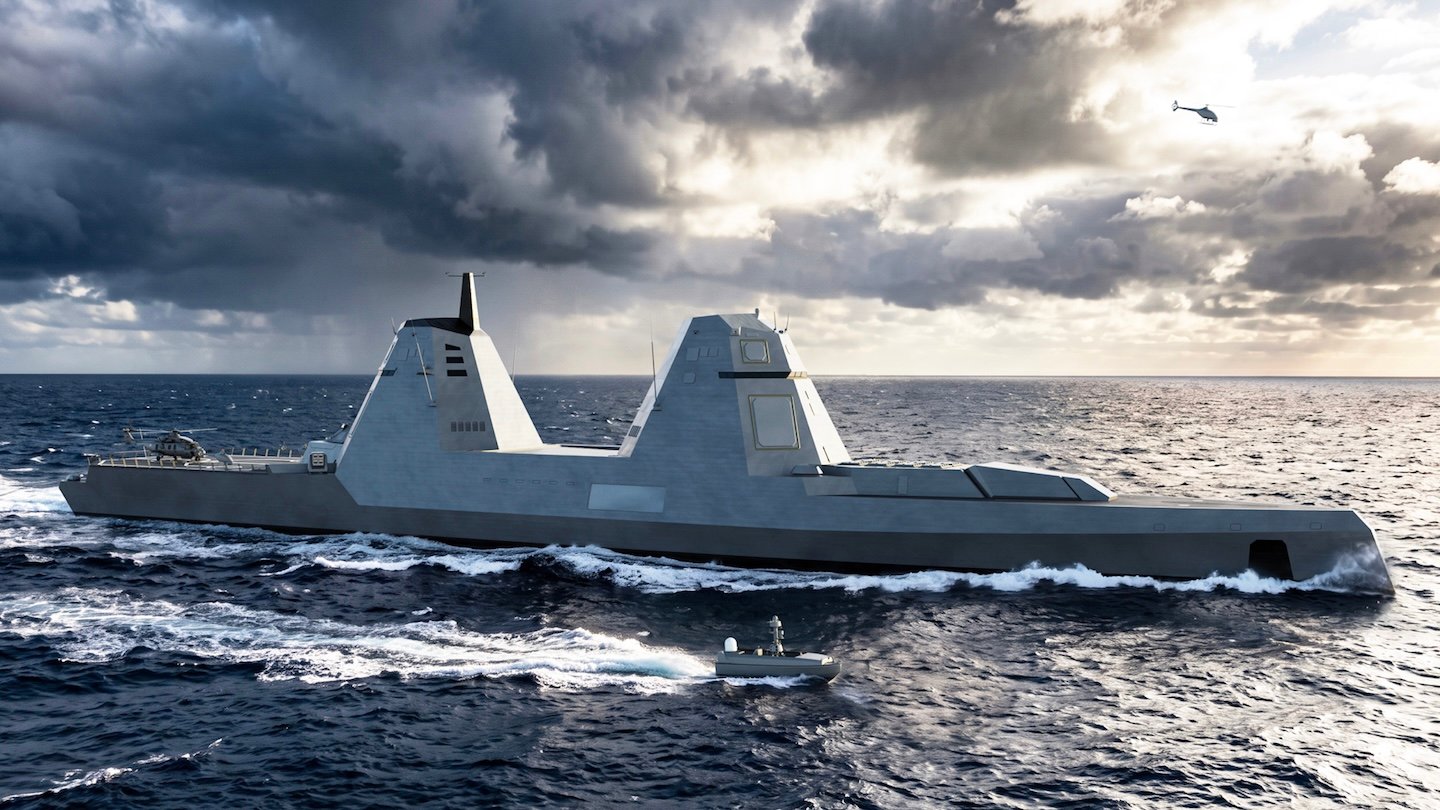
Concept artwork shows a long, low hull with smooth sides and little external clutter. The angular superstructures are intended to reduce radar signatures, while the wave-piercing, knife-like bow resembles the FDI design. Naval Group says the design also accounts for detection from above, including by radar satellites, with particular attention to the upper surfaces of the superstructures.
The most distinctive feature is a pair of widely separated superstructures. Twin-island arrangements, which divide a ship’s functions between two deckhouses, are unusual. The U.K. Royal Navy’s Queen Elizabeth-class aircraft carriers use separate islands for navigation and flight operations. France also studied the arrangement for its future aircraft carrier before choosing a more conventional design.
On the SCX26, the two structures would distribute bridges and sensor equipment. The forward tower is broad, with large square radar panels integrated into its faceted sides. Mer et Marine reports that the largest panels are intended for a new-generation UHF radar, alongside a multifunction active electronically scanned array radar derived from the Sea Fire family used on the FDI frigate. The aft tower is taller and narrower, with a pole mast on top.
Separating sensors could widen coverage, reduce blind arcs and improve resilience by spreading critical equipment across two structures. Naval Group presents redundancy and survivability as aims of the arrangement. The UHF radar is intended to improve long-range detection of difficult targets, including ballistic and hypersonic threats.
Anti-ship ballistic missiles and hypersonic weapons create demanding air-defence problems. Their extreme speed, and in some cases their ability to manoeuvre unpredictably in flight, leaves defenders less time to detect, track and intercept them. Such threats are expected to proliferate. An accompanying infographic depicts anti-ship ballistic missile types used by the Houthis. It was originally published by the International Institute for Strategic Studies in its January 2024 analysis, “Houthi anti-ship missile systems getting better all the time,” and reproduced with permission.
A broad open deck between the two towers is intended as a flexible space for modular weapons and remotely operated equipment. In a video released on Nov. 3, Naval Group showed mass-launcher boxes for drones installed on an FDI frigate. The same equipment could be placed in the destroyer concept’s central zone. The company described the rationale in a social media post: “Because high intensity demands high density and high flexibility.”
The proposed missile system comprises 12 Sylver vertical-launch installations, with eight forward and four aft. Depending on the launcher configuration, the ship could carry as many as 96 missiles, including Aster 30 surface-to-air missiles and MdCN land-attack cruise missiles. Naval Group also identified options to raise capacity beyond 100 missiles, including quad-packed CAMM missiles and future Sylver NG launchers.
Large vertical-launch arrays are a key feature of modern destroyers because they can hold a mix of long- and short-range air-defence missiles and other weapons. Their capacity is relevant to attacks involving large numbers of missiles and drones. Ships have limited opportunities to replenish their stocks at sea and may use expensive interceptors quickly while facing successive waves of threats.
The SCX26 would also carry two multifunctional Rampart launchers for short-range missiles, guided rockets and decoys. On the model displayed at Euronaval, they sit on either side near the rear of the ship, just ahead of the flight deck. A social media post by Revista Conexão Naval described the concept as an 8,000-tonne vessel with an electromagnetic gun, at least 64 missile cells and drones.
Several weapons shown for the concept remain developmental or conceptual. Its primary gun is described as a large-calibre electromagnetic weapon able to fire rapid salvos. A conventional 57 mm gun is also included. Both would be housed in shrouded cupolas intended to preserve the ship’s low-observable features.
Electromagnetic railguns use electric currents and magnetic fields to accelerate projectiles to very high speeds, instead of gunpowder propellants. They could offer long range, rapid fire and relatively inexpensive ammunition, giving a ship another way to attack air, surface and land targets without using its missile stocks. Development has faced major technical difficulties, particularly with generating power, sustained operation and barrel wear. A prototype was tested aboard Japan’s warship Asuka last year. The test was described as the first successful firing of a ship-mounted railgun at an actual target vessel; Japan’s Acquisition, Technology & Logistics Agency documented it.
The design also includes a proposed 100-kilowatt laser mounted high on the forward superstructure. Its elevated position would provide a field of engagement against drones, missiles and other threats. High-energy lasers could offer a lower-cost way to attack drones, small boats and other relatively inexpensive targets without expending conventional missiles. They engage targets at the speed of light and, with adequate electrical power and cooling, can offer a virtually inexhaustible magazine compared with conventional weapons.
Their performance is limited by atmospheric conditions and range, and they must keep a beam on a target. Naval Group therefore presents the laser as a supplement to conventional missiles. A weapon in the 100-kilowatt class would be comparable to the U.S. Navy’s Laser Weapon System Demonstrator, or LWSD, Mk 2 Mod 0, installed on the San Antonio-class amphibious warfare ship USS Portland in 2019.
Aviation and uncrewed-system facilities occupy much of the stern. Beneath the flight deck, a large internal mission bay is intended to hold helicopters and uncrewed aerial, surface and underwater vehicles. An elevator would move equipment between the bay and the deck. The model at Euronaval shows space for one medium helicopter about the size of an NH90 and two smaller landing spots for vertical takeoff and landing drones.
The company’s concept thus treats the destroyer as a floating base for different types of drones, supported by launch, maintenance and storage facilities. A social media post by Philippe Top-Action credited Vincent Lamigeon with photographs of the concept ship at Euronaval 2026. Naval Group has presented the SCX26 as an exploration of future naval combat, with its proposed hull, sensors, weapons and drone operations offered as design ideas rather than a commitment to build the vessel.