
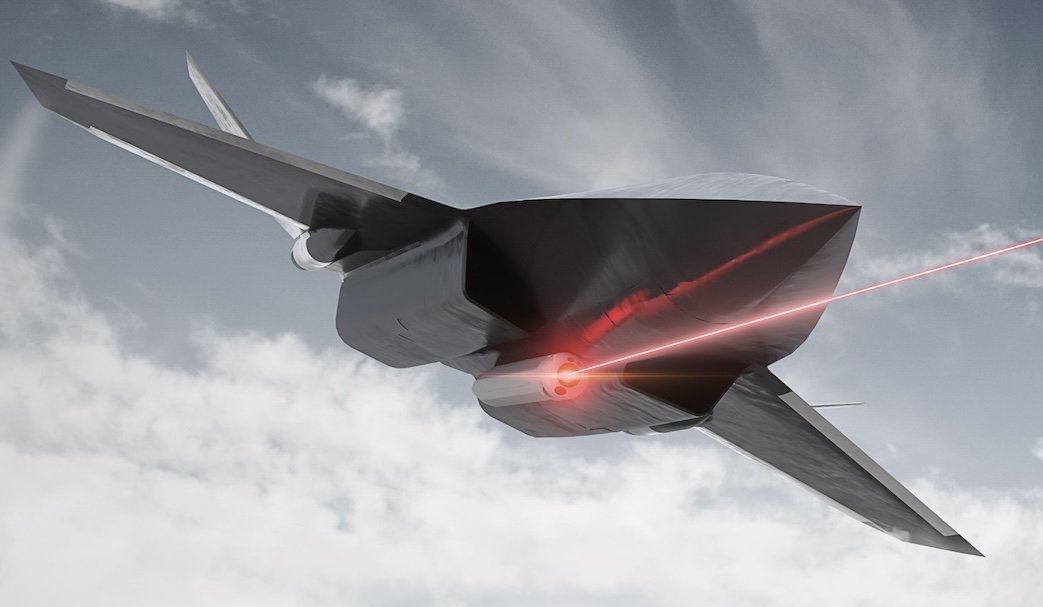
The War Zone has reported:
Germany has contracted MBDA Deutschland to develop a pod-based demonstrator for an airborne laser weapon, beginning the country’s first formal effort to pursue the technology for aircraft. The project is intended to establish technological foundations for future directed-energy capabilities aboard Luftwaffe aircraft, with the longer-term aim of engaging threats such as enemy drones and cruise missiles.
MBDA said it received the contract from the Federal Office of Bundeswehr Equipment, Information Technology and In-Service Support, known as BAAINBw. Essential components for the demonstrator are already being designed. The company has not disclosed the contract value, an expected development schedule, the demonstrator’s specifications, its intended host aircraft or the laser’s output.
The project marks a new application for German laser weapon work that has so far included maritime trials and research for the armed forces. MBDA described airborne laser development as the “supreme discipline” of laser weapon technology, pointing to demanding requirements for the system’s size and weight and its ability to withstand the stresses of flight.
According to MBDA, laser technology has been a strategic priority in German research and development since 2019. It is also designated a key national technology in the German government’s National Security and Defense Industry Strategy, or SVI Strategy. The company has worked on laser effectors and weapons for all branches of the German armed forces, and says it has made substantial investments in the underlying technology in recent years.
MBDA says it has pursued technologies needed for laser weapons since 2008, conducting a series of demonstrations and technology trials. The company says it demonstrated the functionality of a complete laser weapon system as early as 2012. Its existing work on laser sources, beam control, tracking and thermal management could provide a basis for the aircraft project.
A major milestone came in 2021, when MBDA and Rheinmetall received a BAAINBw contract to develop a maritime laser weapon demonstrator for the German Navy. The system was installed aboard the F124 frigate Sachsen in June 2022. It then underwent sea trials that continued until September 2023.
Across six test campaigns spanning nearly a year, the demonstrator carried out more than 100 test firings against different targets under increasingly complex conditions. The trials tested the system’s ability to track highly agile targets, integrate sensors and command systems, and engage targets with its high-energy laser. During a demonstration, the system also successfully shot down a drone.
MBDA and Rheinmetall later moved toward more compact and modular laser configurations, beyond the container-based demonstrator used aboard Sachsen. In September 2024, the companies signed another cooperation agreement to develop a marketable maritime laser weapon, particularly for countering drones.
The aircraft effort brings a different set of engineering demands. A laser adapted from a maritime system must fit within aircraft limits for power, cooling, weight, vibration, volume and aerodynamics. An airborne system needs room for the laser itself, power generation and conditioning equipment, cooling systems, a beam director, tracking sensors and associated electronics.
Managing waste heat is a central challenge because high-energy lasers generate substantial thermal loads. Those loads must be removed without compromising the weapon or other aircraft systems. An external pod would also need to withstand aerodynamic forces, vibration, acceleration and temperature changes while keeping its optics aligned precisely despite aircraft movement.
Atmospheric conditions can further reduce a laser’s effectiveness. Moisture, dust and turbulence can absorb, scatter or distort the beam, reducing the energy that reaches a target. Higher-altitude operation offers some advantages, but does not remove those effects and is not ideal for many drone and cruise missile targets.
A laser’s nominal power rating alone would not establish how well it performs. Beam quality, tracking accuracy, engagement range, atmospheric conditions and the time needed to hold the beam on a target to achieve a kill all affect effectiveness at different distances.
The potential attraction is that an airborne laser could engage incoming threats without using conventional missiles. Its magazine depth could be functionally unlimited while electrical power and cooling capacity remain available. That could help against large waves of drones or cruise missiles, which MBDA identifies as the main targets for a future podded airborne laser.
Demand for lower-cost ways to intercept threats has grown alongside the spread of relatively inexpensive, longer-range one-way attack drones. One example of efforts to increase the number of weapons an aircraft can carry is the 70-millimetre laser-guided Advanced Precision Kill Weapon System II, or APKWS II. Originally designed for air-to-surface attacks, the rocket has become a counter-drone weapon that aircraft can carry in large numbers.
A podded laser could have other uses. Lasers might attack certain soft targets on the surface, where their silence and low visibility to the naked eye could make it harder for an opponent to identify where an attack originated. That role would be limited to certain types of soft targets, if it proved practical.
Aircraft could also use laser pods to defend themselves or other important aerial assets against incoming surface-to-air or air-to-air missiles. A drone carrying such a pod could potentially shoot down missiles headed towards high-value aircraft, including airborne early warning aircraft and tankers, as well as other platforms.
Germany’s initiative comes as the U.S. military reassesses several prominent directed-energy efforts. American laser programs have had difficulty progressing from technology demonstrations to operational deployment.
The U.S. Air Force’s Self-protect High Energy Laser Demonstrator, or SHiELD, was meant to develop a podded laser weapon to protect fighter aircraft from incoming missiles and possibly engage other targets. Despite considerable development work in recent years, the program ended without achieving its central aim of demonstrating a complete laser weapon aboard a fighter aircraft.
Another ambitious U.S. effort, the Airborne High Energy Laser program, sought to equip the AC-130J Ghostrider gunship with a directed-energy weapon for use against ground targets. That mission could also be considered for a future fighter-mounted pod. The AHEL program encountered technical difficulties, and plans to test the system aboard the aircraft were abandoned.